Wer bleibt, hört auf zu plündern — und beginnt zu besteuern.Those who stay stop plundering — and start taxing.
Der Ökonom Mancur Olson beschrieb den entscheidenden Bruch: Der wandernde Räuber nimmt alles, was er kriegen kann, und zieht weiter — er zerstört damit jeden Anreiz, überhaupt etwas zu produzieren. Der sesshafte Räuber dagegen monopolisiert den Diebstahl an einem Ort. Plötzlich hat er ein „umfassendes Interesse" daran, dass seine Beute gedeiht. Er nimmt nicht mehr alles — er nimmt einen festen Anteil. Er nennt es Steuer. Und er bietet etwas an: Schutz.
The economist Mancur Olson described the decisive break: the roving bandit takes everything he can and moves on — destroying any incentive to produce in the first place. The stationary bandit, by contrast, monopolises theft in one place. Suddenly he has an "encompassing interest" in the prosperity of his prey. He no longer takes everything — he takes a fixed share. He calls it tax. And he offers something in return: protection.
Das ist, wie Olson es nannte, der antisoziale Gesellschaftsvertrag — der Ursprung des Staates. Nicht aus einem freiwilligen Bund freier Bürger, sondern aus einer Bande, die gelernt hat, dass langfristige Ausbeutung profitabler ist als kurzfristige Plünderung.
This is what Olson called the antisocial contract — the origin of the state. Not a voluntary covenant of free citizens, but a band that learned long-term extraction is more profitable than short-term plunder.
Der Staat als SchutzgelderpresserThe state as protection racket
Der Soziologe Charles Tilly trieb diesen Gedanken zu Ende. Ein Schutzgelderpresser, schrieb er, ist jemand, der zuerst eine Bedrohung erschafft und dann für ihre Beseitigung kassiert. Genau das tun Regierungen, wenn die Gefahr, vor der sie schützen, eingebildet ist — oder eine Folge ihres eigenen Handelns. Sein berühmtester Satz fasst tausend Jahre Geschichte in sechs Wörter:
The sociologist Charles Tilly took the idea to its conclusion. A racketeer, he wrote, is someone who first creates a threat and then charges to remove it. That is precisely what governments do when the danger they protect against is imaginary — or a consequence of their own actions. His most famous line compresses a thousand years of history into six words:
„Der Krieg machte den Staat, und der Staat machte den Krieg." "War made the state, and the state made war." Charles Tilly, 1985
Olsons Modell ist umstritten — Kritiker wenden ein, dass konkurrierender Diebstahl (Kleptokratie) ein stabiler Zustand bleiben kann und Gewaltmonopol bei Olson zugleich Ursache und Wirkung ist. Als Erklärung von Machtlogik bleibt das Bild jedoch außergewöhnlich tragfähig.
Olson's model is contested — critics note that competitive theft (kleptocracy) can remain a stable equilibrium, and that a monopoly on violence functions as both cause and effect in his account. As an explanation of the logic of power, however, the image remains remarkably durable.
Geld ist Schuld. Das ist kein Bild — es ist Buchhaltung.Money is debt. Not a metaphor — accounting.
Die nächste Stufe ist so subtil, dass die meisten Menschen sie ihr Leben lang nicht sehen. 2014 bestätigte die Bank of England offiziell, was in keinem Schulbuch stand: Banken verleihen nicht die Ersparnisse ihrer Kunden. Sie schöpfen bei jeder Kreditvergabe brandneues Geld — per Buchungssatz, aus dem Nichts.
The next rung is so subtle that most people never see it in their lifetime. In 2014 the Bank of England officially confirmed what no textbook taught: banks do not lend out their customers' savings. They create brand-new money with every loan they issue — by a bookkeeping entry, out of nothing.
Daraus folgt das Unheimlichste am System — und es braucht keine Verschwörung, nur Mathematik: Wenn fast jeder Euro durch Verschuldung entsteht und auf jede Schuld Zins anfällt, dann muss die Geldmenge exponentiell wachsen, allein um nicht zu kollabieren. Schuld und Geld sind zwei Seiten derselben Bilanz. Das System hat keinen Aus-Knopf. Es hat nur Vorwärts.
From this follows the eeriest feature of the system — and it requires no conspiracy, only arithmetic: if nearly every euro arises through debt, and every debt bears interest, then the money supply must grow exponentially simply to avoid collapse. Debt and money are two sides of the same ledger. The system has no off-switch. It only has forward.
Mehr Anspruch als Welt: das Vielfache des Planeten.More claim than world: a multiple of the planet.
Hier wird es schwindelerregend — aber man muss präzise sein, sonst zerlegt es jeder Ökonom. Es ist nicht so, dass mehr Geld existiert als die Welt wert ist. Liquides Geld und reale Jahresleistung sind etwa gleich groß. Was den Planeten um ein Vielfaches übersteigt, ist die Schicht aus Wetten, Ansprüchen und Ansprüchen auf Ansprüche, die sich über der realen Wirtschaft aufgetürmt hat.
Here it becomes vertiginous — but one must be precise, or any economist will dismantle it. It is not true that more money exists than the world is worth. Liquid money and real annual output are roughly equal. What exceeds the planet many times over is the layer of bets, claims, and claims upon claims piled above the real economy.
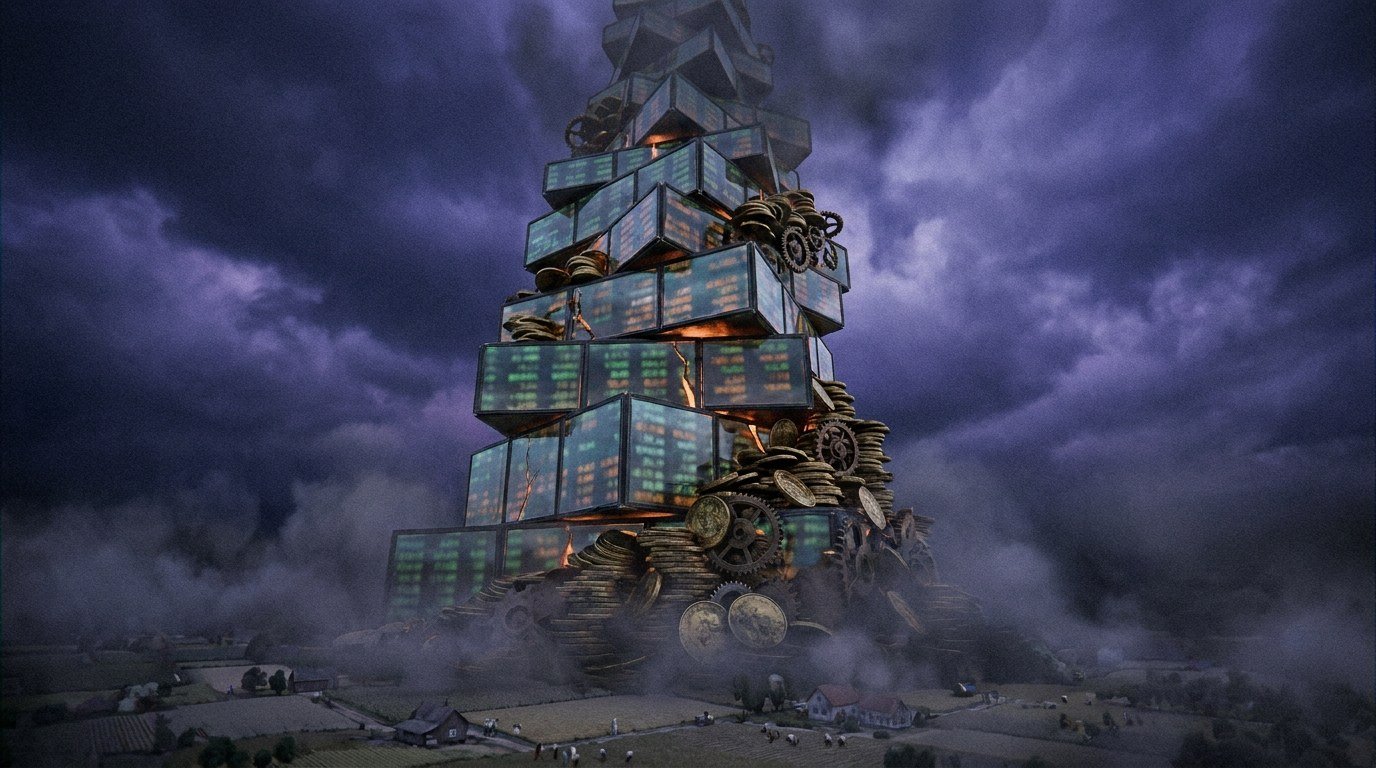
Der Nominalwert ausstehender Derivate erreichte 2025 rund 846 Billionen Dollar (BIS) — mit börsengehandelten Kontrakten nahezu eine Billiarde. Das ist etwa das Acht- bis Neunfache des realen Welt-BIP und rund das Doppelte allen Vermögens des Planeten.
The notional value of outstanding derivatives reached roughly $846 trillion in 2025 (BIS) — close to one quadrillion including exchange-traded contracts. That is about eight to nine times real world GDP, and roughly double all the wealth on the planet.
Der Nominalwert ist nicht echtes Geld — der Bruttomarktwert dieser Derivate liegt „nur" bei ~$21,8 Bio. Aber genau diese Lücke ist die Pointe: Das Finanzsystem ist zu einem selbstreferenziellen Spielfeld geworden, das von der physischen Welt fast vollständig entkoppelt ist. Geld bildet die Realität nicht mehr ab — es hat eine eigene gebaut.
Notional value is not real money — the gross market value of these derivatives is "only" ~$21.8 trillion. But that very gap is the point: finance has become a self-referential playing field, almost entirely decoupled from the physical world. Money no longer represents reality — it has built one of its own.
Krieg und Finanz sind verheiratet — Grönland ist die Hochzeitsanzeige.War and finance are married — Greenland is the announcement.
Der Anthropologe David Graeber zeigt, dass dies kein Zufall ist: Modernes Geld basiert auf Staatsschulden, und Staaten verschulden sich, um Kriege zu führen. Die Gründung der Zentralbanken war nichts anderes als die dauerhafte Institutionalisierung der Ehe zwischen Kriegern und Finanziers. Die Bank of England entstand, um Kriege zu finanzieren; die Federal Reserve ermöglichte, Konflikte ohne unmittelbare fiskalische Grenze zu führen — was Kriege verlängert, weil der Druck wegfällt, Steuern zu erheben.
The anthropologist David Graeber shows this is no accident: modern money is built on state debt, and states take on debt to wage war. The founding of central banks was nothing less than the permanent institutionalisation of the marriage between warriors and financiers. The Bank of England arose to finance war; the Federal Reserve made it possible to wage conflict with no immediate fiscal limit — which prolongs wars, because the pressure to raise taxes disappears.
Wenn eine Person ein Land kaufen willWhen one person wants to buy a country
Im Januar 2026 erklärte Donald Trump den Erwerb Grönlands — einst von ihm „im Grunde ein großer Immobiliendeal" genannt — zur nationalen Priorität. Er drohte acht europäischen Staaten mit Zöllen, „fällig, bis ein Deal für den vollständigen Kauf Grönlands erreicht ist", und schloss militärische Gewalt lange nicht aus. Der Geschäftsfall? Ein Preisschild von rund einer Billion Dollar bei kaum Rendite über zwei Jahrzehnte.
In January 2026, Donald Trump made acquiring Greenland — which he once called "essentially a large real estate deal" — a national priority. He threatened eight European states with tariffs, "due until a deal for the complete purchase of Greenland is reached," and long refused to rule out military force. The business case? A price tag of roughly one trillion dollars for almost no return over two decades.
Grönland ist deshalb so verstörend, weil hier der sesshafte Räuber kurz wieder zum wandernden wird: offene Drohung, Zoll als Wirtschaftskrieg, Land als Kaufobjekt. Die Maske verrutscht. Dänemarks Premierministerin zog die einzige Linie, die zählt: Über Sicherheit, Investitionen, Wirtschaft könne man verhandeln — „aber nicht über unsere Souveränität." Genau dort, an dieser Grenze, beginnt das letzte Kapitel.
Greenland is so disturbing because here the settled bandit briefly reverts to a roving one: open threat, tariff as economic warfare, land as merchandise. The mask slips. Denmark's prime minister drew the only line that matters: security, investment, the economy can be negotiated — "but not our sovereignty." Precisely at that boundary the final chapter begins.
Wie die Psyche lernt, dass alles einen Preis hat.How the psyche learns that everything has a price.
Der Philosoph Michael Sandel beschreibt die stillste Eroberung von allen: In den letzten Jahrzehnten haben Marktwerte nicht-marktliche Normen aus fast jedem Lebensbereich verdrängt. Fast unbemerkt sind wir von einer Marktwirtschaft zu einer Marktgesellschaft abgedriftet — einer Welt, in der nahezu alles käuflich ist.
The philosopher Michael Sandel describes the quietest conquest of all: over recent decades, market values have crowded nonmarket norms out of almost every sphere of life. Almost imperceptibly we have drifted from a market economy to a market society — a world in which nearly everything is for sale.
Sein schärfstes Beispiel: Eine Kita führte eine Geldstrafe für zu spätes Abholen ein — und die Verspätungen stiegen. Die Eltern behandelten die Strafe als Gebühr, die sie zu zahlen bereit waren, statt Pünktlichkeit als Pflicht zu begreifen. Sobald ein Preis dranhängt, kippt eine moralische Verpflichtung in eine Transaktion. Wer in dieser Welt aufwächst, lernt nicht „manches ist unkäuflich" — sondern „alles hat einen Preis, ich kenne ihn nur noch nicht."
His sharpest example: a daycare introduced a fine for late pickups — and lateness rose. Parents treated the fine as a fee they were willing to pay, rather than seeing punctuality as an obligation. The moment a price is attached, a moral duty tips into a transaction. A child raised in this world does not learn "some things cannot be bought" — but "everything has a price, I just don't know it yet."
Und jene, die Geld nicht erreicht? Man kauft sie nicht. Man benennt sie um.And those money cannot reach? You don't buy them. You rename them.
Die Forschung zu heiligen Werten (Philip Tetlock, Scott Atran) liefert den empirischen Beweis, dass es solche Menschen gibt. Bittet man jemanden, einen heiligen Wert gegen Geld zu tauschen — einen „Tabu-Tausch" —, reagiert er mit Empörung, Wut, Ekel und wird in Verhandlungen unnachgiebiger. Der frappierende Befund: Ein Geldangebot erzeugt einen Backfire-Effekt — der Mensch wird noch unwilliger, als wenn gar kein Geld im Spiel wäre. Für manche ist Geld nicht egal. Es ist beleidigend.
Research on sacred values (Philip Tetlock, Scott Atran) proves empirically that such people exist. Ask someone to trade a sacred value for money — a "taboo trade-off" — and they respond with outrage, anger, disgust, and become more intransigent in negotiation. The striking finding: a monetary offer triggers a backfire effect — the person becomes even less willing than if no money had been mentioned at all. For some, money isn't irrelevant. It's an insult.
Die dunkle AntwortThe dark answer
Wie also bringt das System die Unkäuflichen „wieder unter Kontrolle"? Nicht mit mehr Geld. Die Forschung zeigt drei Wege — und alle drei sind unsichtbarer als jede Münze:
So how does the system bring the unbuyable "back under control"? Not with more money. The research reveals three routes — and all three are more invisible than any coin:
Die wirksamste Kontrolle über Menschen, die Geld nicht erreicht, läuft nie über Geld — sondern über Sprache, Schuld und Identität. Wer das durchschaut, ist immun. The most effective control over people money cannot reach never runs through money — but through language, debt, and identity. Whoever sees through this is immune.
Das ist die Linie, die sich durch alle sechs Stufen zieht: Der Räuber wird mit jeder Stufe unsichtbarer. Schwert, Steuer, Schuld, Geld, Markt, Narrativ. Sichtbare Gewalt ist teuer und weckt Widerstand. Unsichtbare Gewalt nennt sich Normalität. Aufklärung heißt: die Stufen wieder sichtbar machen.
This is the thread running through all six rungs: with each step the bandit grows more invisible. Sword, tax, debt, money, market, narrative. Visible force is expensive and provokes resistance. Invisible force calls itself normality. Enlightenment means: making the rungs visible again.
Sechs Stufen. Eine Bewegung: von der Faust zum Gedanken.Six rungs. One motion: from fist to thought.
Was der Preis mit der Seele macht — und warum die Zahl uns blind macht.What the price does to the soul — and why the number makes us blind.
Wenn das Leben einen Preis bekommtWhen life gets a price
Immanuel Kant zog die schärfste Linie der ganzen Frage: Dinge haben einen Preis — sie sind gegen ein Äquivalent austauschbar. Der Mensch (und, so dürfen wir es weiten, das Lebendige) hat Würde — und Würde ist „über allen Preis erhaben" und kennt kein Äquivalent. In dem Augenblick, in dem ein Lebewesen ein Preisschild bekommt, wird es vom Zweck an sich zum Mittel. Das ist kein moralisches Gefühl, sondern eine kognitive Umschaltung — und sie hat messbare Folgen.
Immanuel Kant drew the sharpest line in the whole question: things have a price — they can be exchanged for an equivalent. The human being (and, we may extend it, the living) has dignity — and dignity is "above all price" and admits of no equivalent. The moment a living being receives a price tag, it turns from an end in itself into a means. This is not a moral sentiment but a cognitive switch — and it has measurable effects.
Die Psychologie kennt drei Wirkungen:
Psychology knows three effects:
Zusammen ergeben sie ein Werkzeug von kalter Effizienz: Der Preis verwandelt das Lebendige in Vergleichbares — und schaltet im selben Moment das Gefühl dafür ab. So wird das Unerträgliche verwaltbar. Genau deshalb braucht es die Achse: einen Kern, der per Definition keinen Preis trägt, damit die Würde nicht in die Vergleichbarkeit gezogen wird.
Together they form a tool of cold efficiency: the price turns the living into the comparable — and in the same instant switches off our feeling for it. The unbearable becomes administrable. This is exactly why an axis is needed: a core that by definition bears no price, so that dignity is never pulled into comparability.
Die Tyrannei der ZahlThe tyranny of the number
Und damit zu unserer großen Problematik mit der Statistik. Statistik macht die Welt lesbar — und Lesbarkeit ist die Vorbedingung von Kontrolle. Der Anthropologe James C. Scott zeigte: Staaten (und Märkte) müssen Bevölkerungen zählbar machen, um sie zu regieren. Die Volkszählung ist das Werkzeug des sesshaften Räubers — er muss zählen, um zu besteuern. Statistik ist nie neutral; sie ist von Anfang an die Brille der Macht.
And so to our great problem with statistics. Statistics make the world legible — and legibility is the precondition of control. The anthropologist James C. Scott showed: states (and markets) must render populations countable in order to govern them. The census is the tool of the settled bandit — he must count in order to tax. Statistics are never neutral; from the outset they are the lens of power.
Drei Fallen folgen daraus:
Three traps follow:
Goodharts Gesetz: Sobald eine Kennzahl zum Ziel wird, taugt sie nicht mehr als Maß — wer die Zahl optimiert, zerstört oft das, wofür sie nur ein Stellvertreter war. Der McNamara-Fehlschluss: Miss, was messbar ist; ignoriere den Rest; erkläre das Unmessbare für unwichtig — und schließlich für nicht existent. Der Durchschnitt löscht den Menschen: Politik für den Mittelwert macht die wirkliche Verteilung realer Einzelner unsichtbar.
Goodhart's Law: once a measure becomes a target, it ceases to be a good measure — optimise the number and you often destroy the thing it merely stood for. The McNamara fallacy: measure what is measurable; ignore the rest; declare the unmeasurable unimportant — and finally non-existent. The average erases the person: policy for the mean makes the real distribution of actual individuals invisible.
Statistik kann nur sehen, was vergleichbar — also bepreisbar — gemacht wurde. Ein System, das von Zahlen regiert wird, ist genau dort blind, wo die Würde wohnt. Statistics can only see what has been made comparable — that is, priceable. A system ruled by numbers is blind precisely where dignity lives.
Das BIP ist das Lehrstück: Es misst Aktivität, nicht Wohlergehen — es zählt den Autounfall, die Scheidung, die Ölkatastrophen-Reinigung als „Wachstum". Es misst, wie Robert Kennedy 1968 sagte, alles außer dem, was das Leben lebenswert macht. Die Zahl ist die Erkenntnistheorie der bepreisten Welt — und ihre blinde Stelle ist kein Zufall, sondern Bauart.
GDP is the textbook case: it measures activity, not wellbeing — it counts the car crash, the divorce, the oil-spill cleanup as "growth". As Robert Kennedy said in 1968, it measures everything except what makes life worthwhile. The number is the epistemology of the priced world — and its blind spot is not an accident but a design.
Eine Wahrheit, sieben Linsen. Keine Feinde — nur unterschiedliche Horizonte.One truth, seven lenses. No enemies — only different horizons.
Jede Disziplin ertastet einen anderen Teil desselben Elefanten. Wir legen sie nebeneinander — auch die orthodoxe Ökonomie, der wir ihr Recht lassen. Erst zusammen ergibt sich das Bild.
Each discipline feels a different part of the same elephant. We lay them side by side — including orthodox economics, to which we grant its due. Only together do they form the picture.
Viele Reparaturen. Jede trifft eine Stufe — keine den ganzen Turm.Many repairs. Each strikes one rung — none the whole tower.
Bevor wir einen eigenen Weg vorschlagen — die ehrliche Landkarte der bekannten Lösungsansätze, mit Versprechen und Fallstrick. Keiner ist dumm. Jeder ist unvollständig.
Before proposing our own path — an honest map of the known approaches, with promise and trap. None is foolish. Each is incomplete.
Das Muster ist deutlich: Fast jeder Entwurf behandelt Kapitalismus und Kommunismus als Entweder-Oder — zwei Türme, zwischen denen man wählt. Genau das ist der Denkfehler von zweihundert Jahren. Beide tragen eine Wahrheit. Beide einen Schatten. Was, wenn man sie nicht wählt, sondern verschränkt?
The pattern is clear: nearly every design treats capitalism and communism as either/or — two towers to choose between. That is the two-hundred-year error. Both carry a truth. Both a shadow. What if you don't choose between them, but interlock them?
Wir rechnen mit der Physik von 1870. Die Welt aber ist ein lebendes System.We compute with the physics of 1870. But the world is a living system.
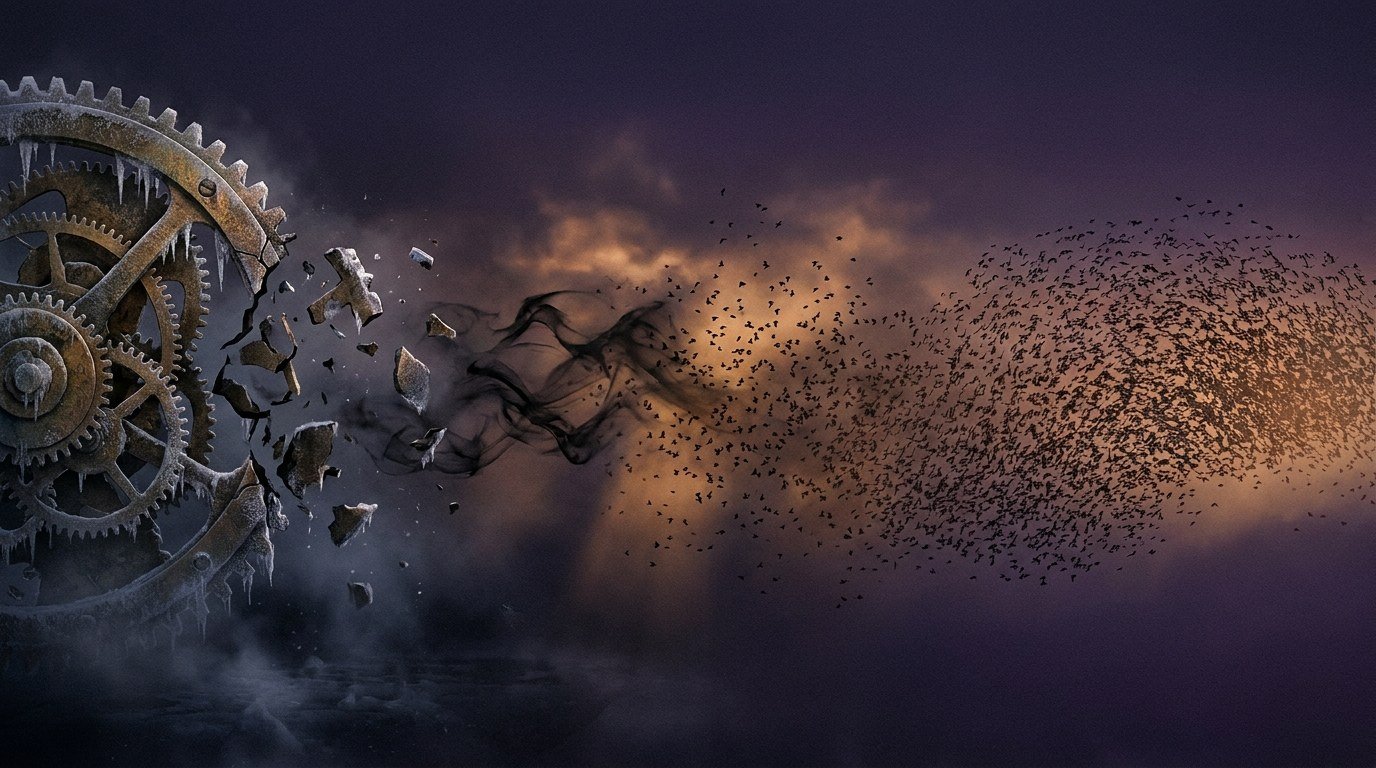
Die klassische Ökonomie lieh sich ihr Weltbild von der Mechanik des 19. Jahrhunderts: ein System, das zu einem stabilen Gleichgewicht strebt, bevölkert von rationalen Optimierern. Das war eine große Leistung — für eine industrielle Welt. Doch es ist ein Standfoto eines strömenden Flusses.
Classical economics borrowed its worldview from 19th-century mechanics: a system tending toward a stable equilibrium, populated by rational optimisers. That was a great achievement — for an industrial world. But it is a still photograph of a flowing river.
Hier ist Würde wichtig, nicht Schuldzuweisung. Die „Wirtschaftsweisen" und ihre Kolleginnen weltweit sind keine Hexenmeister und keine Gegner. Sie sind Kartografen — und ihre Karte war für ihr Gelände erstaunlich genau. Nur hat sich das Gelände verändert: digital, finanzialisiert, an den ökologischen Grenzen, komplex und vernetzt. Eine Karte des ruhigen Flusses hilft wenig, wenn der Fluss über die Ufer tritt. Das Problem ist das Paradigma, nicht die Person.
Here dignity matters, not blame. The "wise economists" and their colleagues worldwide are no sorcerers and no enemies. They are cartographers — and their map was remarkably accurate for its terrain. The terrain simply changed: digital, financialised, at ecological limits, complex and networked. A map of the calm river helps little once the river breaks its banks. The problem is the paradigm, not the person.
Das alte Bild — GleichgewichtThe old image — equilibrium
Das lebende Bild — StrömungThe living image — current
Donella Meadows, Pionierin des Systemdenkens, zeigte: Der mächtigste Hebelpunkt eines Systems ist nicht eine Regel oder ein Zinssatz — es ist das Paradigma, aus dem das System entspringt. Will man das System wirklich ändern, ändert man den Denkrahmen. Eine dynamische Zukunft beginnt nicht mit einer neuen Vorschrift, sondern mit einem neuen Bild.
Donella Meadows, a pioneer of systems thinking, showed: the most powerful leverage point of a system is not a rule or an interest rate — it is the paradigm the system springs from. To truly change the system, change the frame. A dynamic future begins not with a new regulation but with a new image.
Und genau hier ist die Merkaba kein Zufallssymbol. Das Gleichgewicht der alten Ökonomie ist ein Stillstand — zwei Kräfte, die sich neutralisieren. Die Merkaba ist das Gegenteil: zwei Tetraeder, die sich gegeneinander drehen und nie zur Ruhe kommen. Lebendiges Gleichgewicht ist Bewegung, nicht Stillstand. Eine dynamische Zukunft braucht ein dynamisches Bild — und genau das liefert die dritte Säule.
And here the Merkaba is no accidental symbol. The equilibrium of the old economics is a standstill — two forces cancelling out. The Merkaba is the opposite: two tetrahedra spinning against each other, never coming to rest. Living balance is motion, not stillness. A dynamic future needs a dynamic image — and that is exactly what the third pillar provides.
Chazon: zwei Systeme, gegenläufig gedreht, gehalten von einer unkäuflichen Achse.Chazon: two systems, counter-rotating, held by one unbuyable axis.
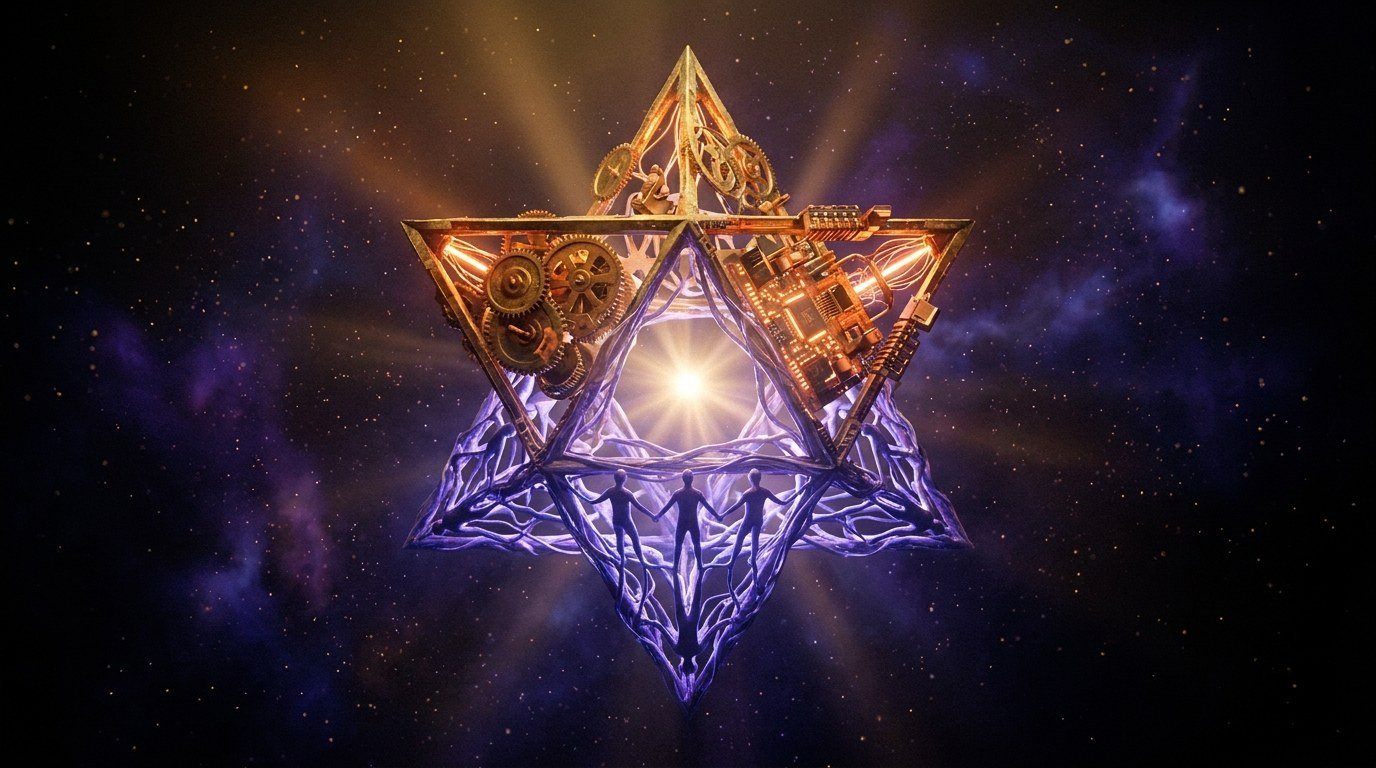
Die Merkaba — der Stern-Tetraeder, zwei ineinander verschränkte Pyramiden — ist kein Symbol für Kompromiss. Ein lauer „dritter Weg", eine Mischwirtschaft, wäre nur ein halber Motor auf halbem Boden. Die Merkaba ist ein gegenläufiges Gleichgewicht: beide Prinzipien vollständig vorhanden, gegeneinander rotierend, jeder begrenzt den Schatten des anderen.
The Merkaba — the star tetrahedron, two interlocked pyramids — is not a symbol of compromise. A lukewarm "third way", a mixed economy, would be only half an engine on half a floor. The Merkaba is a counter-rotating equilibrium: both principles fully present, spinning against each other, each checking the other's shadow.
Der Motor — Markt & KapitalThe engine — market & capital
Der Boden — Commons & SolidaritätThe floor — commons & solidarity
Die Achse: Chazon, der ruhende KernThe axis: Chazon, the still core
Im Zentrum der Merkaba steht kein System, sondern ein Maßstab. Die Achse — Chazon, „Vision" — ist der unkäufliche Kern, den weder Markt noch Staat bepreisen oder besitzen darf: Menschenwürde, Leben, die Commons der Natur, Fürsorge, Sinn. Genau das, was Kapitel VI verteidigt. Damit beantwortet die Achse die Frage, die Sandel offen ließ — er nannte nie das Kriterium, was Markt werden darf und was nicht. Das Kriterium ist die Heiligkeit: Was zur Würde des Menschen gehört, wird konstitutionell aus beiden Tetraedern herausgenommen.
At the centre of the Merkaba stands no system, but a measure. The axis — Chazon, "vision" — is the unbuyable core that neither market nor state may price or own: human dignity, life, the commons of nature, care, meaning. Exactly what Chapter VI defends. With this, the axis answers the question Sandel left open — he never named the criterion for what may be marketised and what may not. The criterion is sanctity: whatever belongs to human dignity is constitutionally lifted out of both tetrahedra.
Der Boden — schuldfreies Geld für das UnverhandelbareThe floor — debt-free money for the non-negotiable
Öffentlich geschöpftes, schuldfreies Geld trägt Pflege, Würde und die ökologischen Commons. Die kommunistische Wahrheit — ohne den Zwang.
Publicly created, debt-free money carries care, dignity and the ecological commons. The communist truth — without the coercion.
Der Motor — freier Markt auf dem Boden, nicht statt seinerThe engine — a free market on the floor, not instead of it
Wettbewerb und Preissignale für alles, was wirklich davon profitiert — getragen vom Boden, nie ihn ersetzend. Die kapitalistische Wahrheit — ohne die Raubzüge.
Competition and price signals for everything that genuinely benefits — resting on the floor, never replacing it. The capitalist truth — without the raids.
Die Achse — der Kern, der nichts bepreistThe axis — the core that prices nothing
Sie bepreist nichts — sie zieht die Grenze: Was darf Markt werden, was nie? Die Achse hält Motor und Boden im Gleichgewicht.
It prices nothing — it draws the line: what may become market, what never? The axis holds engine and floor in balance.
Das ist eine Vision, kein erprobter Bauplan. Die offene Flanke: Wer bewacht die Achse? Wer entscheidet die Grenze — und wie verhindert man ihre Kaperung? Die Grenzziehung ist selbst politisch. Doch der Keim existiert real: Die Genossenschaft (Shalem eG) ist schon ein Boden-Motor-Hybrid — Markt im Dienst, Eigentum bei den Menschen, Entscheidung bei den Beteiligten. Chazon skaliert dieses Prinzip zur Geldordnung.
This is a vision, not a tested blueprint. The open flank: who guards the axis? Who decides the line — and how is its capture prevented? Drawing the boundary is itself political. Yet the seed already exists in the real world: the cooperative (Shalem eG) is already a floor-engine hybrid — market in service, ownership with the people, decision with the participants. Chazon scales this principle into a monetary order.
Der Kapitalismus fragt: „Was ist es wert?" Der Kommunismus fragt: „Wem gehört es?" Chazon fragt zuerst: „Was ist heilig — und darf darum gar nicht erst auf den Markt?" Capitalism asks: "What is it worth?" Communism asks: "Who owns it?" Chazon asks first: "What is sacred — and therefore must never reach the market at all?"
Erst diese dritte Frage hält die beiden anderen im Gleichgewicht. Das ist die dritte Säule — nicht zwischen den Systemen, sondern über ihnen.
Only that third question holds the other two in balance. That is the third pillar — not between the systems, but above them.