






Project Enlightenment · Overview
Project Enlightenment · Part II · Deep Dive Segment 02
The Age of Kings
How power hit upon the idea of passing itself down through its own blood, and why the maddest structures in history grew out of it: nobility, feudalism, marriage politics, inbreeding, and the golden cage of Versailles.
Blood is a fiction. But it was the fiction that solved three deadly problems of power at once, before it ended up devouring itself.
Listen (read by Mira)
I · Why One Man?
The Bandit Who Settled Down
Before there was blood, there was violence. Picture anarchy: roving robbers who take what they can and move on. They plunder everything, because tomorrow they will be somewhere else. Economists call this the roving bandit.
But one of them calculates differently. If he stays and monopolizes the plundering (taking only a fixed share instead of everything), then it pays for the peasants to start producing again. The robber becomes a stationary bandit: he taxes instead of plundering, protects “his” peasants from other robbers, because a prosperous population yields more tax. He has developed an encompassing interest in his territory. That is the origin of the state and of the king.

War made the state, and the state made war.
Why one man at the top and not a council? Because the most pressing business was waging war, and a single commander decides faster than a committee. Over centuries, permanent war relentlessly selects for centralized, commanding power. The king is the bandit who won the competition and settled down.
II · The Core Problem
The Deadliest Problem of Any Power: Succession
Here lies the key to your entire question. The stationary bandit has a problem that kills him: what happens when he dies?
Without a rule, every death of a ruler means civil war: every strongman grabs for the crown, the realm falls apart, the painstakingly built order goes up in flames. Every generation, all over again. A realm that fails to solve this does not survive.
So a rule is needed that makes succession predictable. And here comes a deep insight: a bad rule beats no rule. Why “the eldest son”? Because this criterion is indisputable. “The most capable” can be disputed endlessly, and every dispute is a reason for war. “The king’s firstborn son,” by contrast, is unambiguous, recognizable to everyone, non-negotiable.
Heredity is not superstition. It is the clearest fixed point that everyone can agree on without fighting.
III · The Logic of Blood
Why One’s Own Blood, of All Things?
Heredity solves more than succession. It is so irresistible because it unlocks three deadly problems with a single key:
Lock 1
Succession
The unambiguous fixed point prevents a war of succession in every generation.
Lock 2
Trust
In a world without contracts and bureaucracy, there is only one thing you can trust: your own blood. The king fills the key posts with relatives.
Lock 3
Legitimacy
He who rules by birth did not “seize” anything. Not ambition but God/nature gave it to him. Naked power disappears behind birthright.
unlocked by a single key → Blood
On top of that, a bonus that produces genuine quality of government: whoever can bequeath his power thinks long-term. The dynastic bandit plants trees in whose shade only his grandchildren will sit: he builds instead of merely plundering, because his line will reap the harvest. That is exactly why the theory of the stationary bandit itself points to the dynasty as the best solution: it extends the ruler’s time horizon.
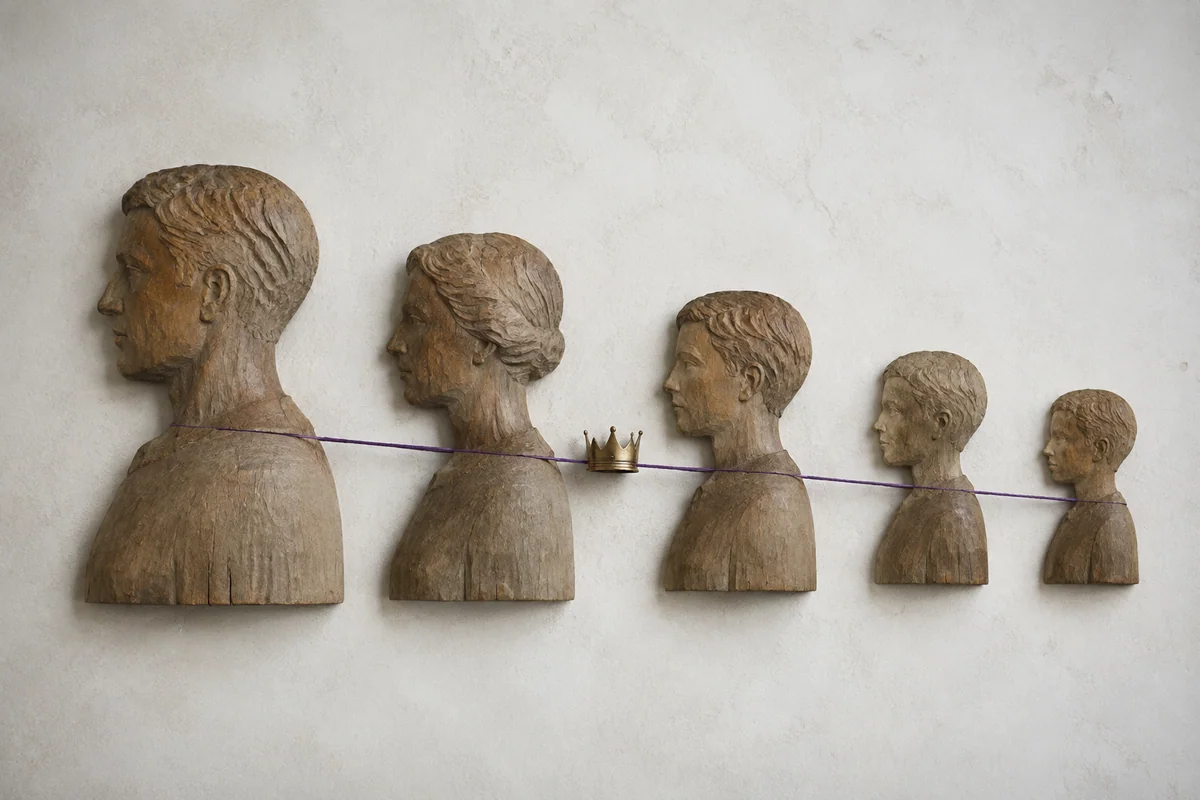
And at the very bottom lies the reflex from Segment 01: the ultimate in-group is one’s own children.
Kin selection: the biological urge to favor one’s own genes. The man who fought his way to the top wants his blood to keep the spoils. The fiction of power and primal instinct collapse into one here.
IV · The Cascade
How One King Became an Entire Nobility
A king cannot rule alone. He needs local enforcers, tax collectors, soldiers. So he grants land and authority to his followers, in exchange for loyalty and military service. That is the core of feudalism: land for loyalty.
But these followers want to secure their line just as the king secures his. So they, too, make their fiefs hereditary. The logic of blood cascades downward, through the entire pyramid.
Nobility is nothing but frozen, heritable, delegated power.
The title becomes property. The commander of a stretch of land becomes a duke, a count, a baron: each a little king on his own patch, each obsessed with his own bloodline. And so a single rule (“power stays in the blood”) gives rise to an entire cosmos of ranks.
V · Exported Violence
Primogeniture: the Rule That Gave Birth to Crusades and Colonies
Now a new problem arises. If a nobleman divides his land among all his sons, the estate shrinks to dust within a few generations, and with it the power. The solution: primogeniture. The firstborn inherits everything, and the power block stays intact.
But this creates a dangerous side effect: a permanent surplus of landless, armed, ambitious younger sons. They have a sword and a family tree, but no land. What to do with them?
They seek land and glory elsewhere: in the Church, in mercenary war, in the Crusades, later in colonial conquest.
A simple inheritance rule, designed to keep property together, thus exported violence across half the planet for centuries. The inner logic of blood became outward conquest. No accident: a direct mechanical consequence.
VI · Marriage as a Weapon
War by Other Means: Marriage Politics
If power lives in the blood, then marriage is anything but romantic: it is mergers and acquisitions. Why conquer a territory when you can marry its heiress? The family tree becomes the map of power; a wedding can shift a kingdom.
No one mastered this as brilliantly as the Habsburgs. Their famous motto, a verse of Ovid’s, repurposed for them:
“Bella gerant alii, tu felix Austria nube.” Let others wage wars. You, happy Austria, marry.
Through skillful marriages they won Burgundy, Spain, Bohemia, Hungary, and with them an empire “on which the sun never set,” without fighting a single battle. Dynastic marriage was Europe’s mergers-and-acquisitions market, and genealogy became an obsession, because a marriage contract could move more than a military campaign.
VII · The Collapse
When the System Devoured Its Own Blood
This is where the madness becomes visible. If you may only marry equals in rank (and preferably within the family, to bundle property and claims), the gene pool collapses. Uncle married niece, cousin married cousin, generation after generation. Among the Spanish Habsburgs, more than 80% of marriages were unions between blood relatives.
- Kennzahl
- F = 0.254
- Charles II of Spain: “El Hechizado,” the Bewitched. His inbreeding coefficient was higher than that of a child born to siblings. The notorious “Habsburg jaw” so pronounced that he could barely chew; severely disabled in body and mind, unable to father children.
With his death in 1700, the Spanish line of the Habsburgs was extinguished, triggering the War of the Spanish Succession, which set half of Europe ablaze. The obsession with the purity of blood had destroyed the blood itself.
The machine built to preserve power in the blood ended up devouring its own blood.
VIII · The Golden Cage
How to Turn Warriors into Courtiers
A hereditary nobility has a problem: it must be visibly different to justify its precedence. Hence the flood of signals: coats of arms, dress codes (sumptuary laws that specified exactly who was allowed to wear which fabric), etiquette, ceremony. Status that no longer has to prove itself must endlessly display itself.
And then the most cunning move of all: Versailles. For centuries, the warlike, dangerous nobles had been the greatest threat to the king. Louis XIV solved this by drawing them to his court and turning them into courtiers: men who now competed over who would be allowed to hand the king his shirt.
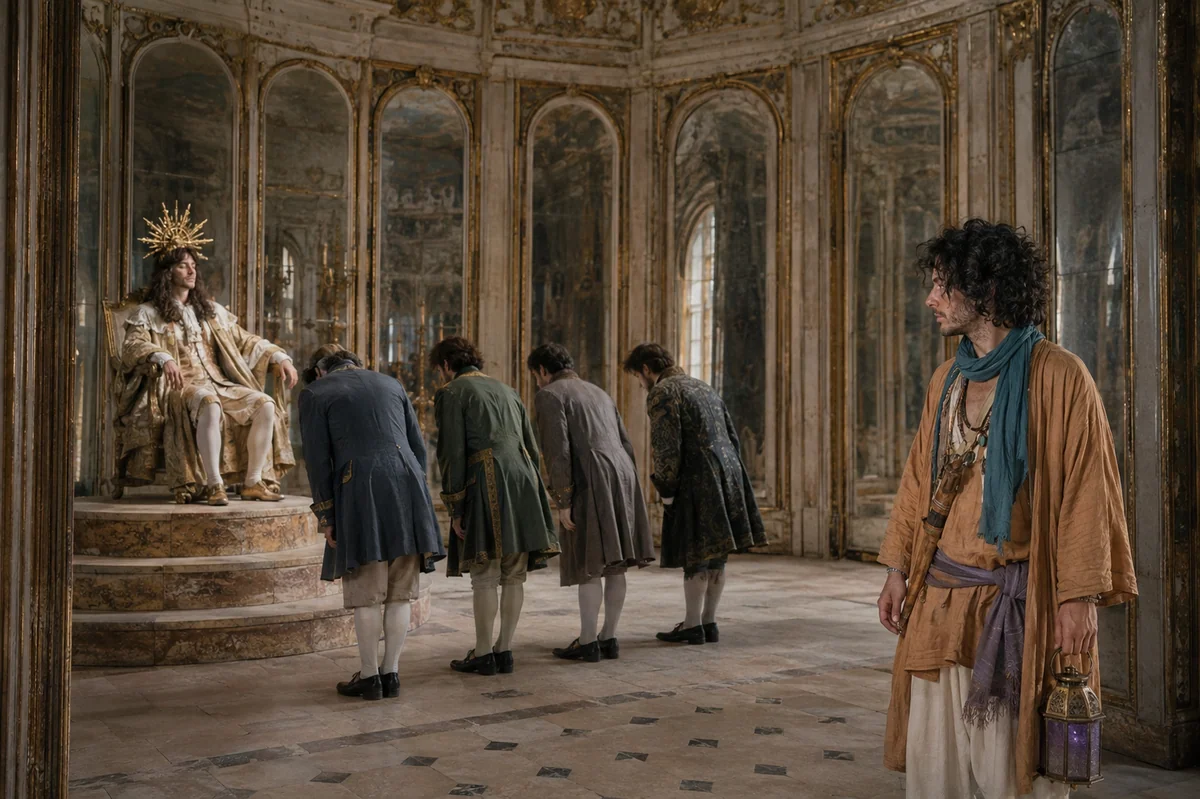
Power migrated from the sword to ritual. The cage was made of gold, but it was a cage.
The warrior was tamed into a civilized man; his energy no longer flowed into rebellion, but into manners, rank, and courtly games of intrigue. The nobility had domesticated its own predators.
IX · The End
When a New Fiction Beat Blood
Every fiction has a built-in breaking point. Blood’s was its boldest claim: that one infant is better from birth than another. As long as everyone believed it, the system held. But two forces undermined it.
First, money: a bourgeois class grew rich through trade and skill: power that did not come from blood and called the whole principle into question. Second, the Enlightenment, which ignited a counter-fiction more powerful than any coat of arms: “All men are born equal.”
This sentence did not merely remove a king. It attacked the master fiction itself: the idea that blood means anything at all.
1789. The age of kings does not end because people stop believing in fictions. It ends because a new, stronger fiction displaces the old one: the nation, the people, the citizen, capital. It is exactly the pendulum swing from the main line: a counter-voice, “all are equal,” finally cracked the machine’s oldest mechanism.
The Deep Dive in One Sentence
Blood was not madness but power’s most ingenious solution: it tied succession, trust, and legitimacy into a single knot. Yet every solution carries its own death within it, and so the same logic forced the dynasties into inbreeding, their sons into conquest, and in the end up against a new fiction that no family tree could withstand.
✦ · Sources
Sources & Traces
The theories, terms, and historical cases this deep dive rests on. BOOK = work · TERM = key term · CONCEPT = theory/model.
Why Rule & the State Emerge
- Concept · Mancur Olson: The Stationary Bandit: How the robber becomes a state, and why the dynasty is his logical solution. ↗
- Concept · Charles Tilly: “War made the state”: Permanent war as the engine of state centralization. ↗
- Concept · Schelling Point (Focal Point): Why an unambiguous rule, “the eldest,” prevents a war of succession. ↗
The Logic of Blood
- Term · Divine Right of Kings: The theology that declared birthright a cosmic order (Bossuet, James I). ↗
- Concept · Kin Selection: The biological urge to favor one’s own blood: the root beneath the dynasty. ↗
- Term · Inheritance & Succession to the Throne: The systems of rules meant to make succession predictable. ↗
The Construction of the Nobility
- Term · Feudalism: Land for loyalty, and how heredity cascaded down the entire pyramid. ↗
- Term · Primogeniture: The firstborn rule, and the surplus of landless sons pressing outward. ↗
- Term · Sumptuary Laws: Dress codes as visible markers of rank. ↗
- Book · Norbert Elias: The Civilizing Process: How Versailles turned the warrior nobility into competing courtiers. ↗
Marriage, Inbreeding & the Collapse
- Book · House of Habsburg: the Marriage Dynasty: “Bella gerant alii, tu felix Austria nube”: conquest by marriage contract. ↗
- Book · Charles II of Spain: “El Hechizado”: the human end product of inbreeding; with him the line died out in 1700. ↗
- Concept · Alvarez et al. (PLOS ONE, 2009): The genetic study: inbreeding coefficient from 0.025 to 0.254 in five generations. ↗
- Term · War of the Spanish Succession: What happens when the blood rule fails: all of Europe at war. ↗