

06 · The Money & Debt System
The stationary bandit.
Bands of robbers eventually settled down. Whoever stays can no longer plunder everything. He needs finer instruments of control. The history of money is the history of that refinement: from the sword to the tax to debt, to money, to the market, all the way to control over thought itself.
Listen (read by Mira)
CHAZON STUDIO · Video in German
The money system on film
Source Open traces how settlement, ownership and money became structures of power.
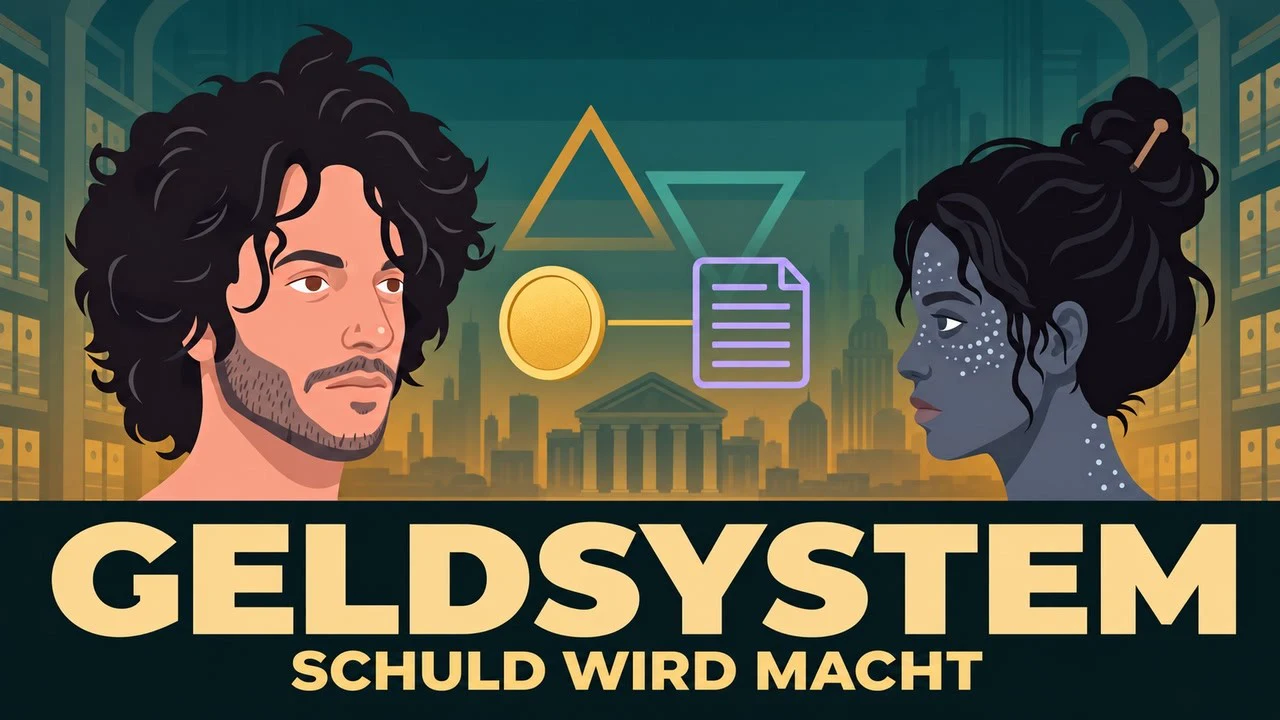
Der sesshafte Räuber: Wie unser Geldsystem Macht schafft
Open on YouTube ↗
I / VI · From Plunder to Rule
Whoever stays stops plundering. And starts taxing.
The economist Mancur Olson described the decisive break: the roving bandit takes everything he can get and moves on, destroying, in the process, any incentive to produce anything at all. The stationary bandit, by contrast, monopolizes theft in one place. Suddenly he has an “encompassing interest” in seeing his prey thrive. He no longer takes everything. He takes a fixed share. He calls it a tax. And he offers something in return: protection.
That is what Olson called the antisocial social contract: the origin of the state. Born not of a voluntary covenant of free citizens, but of a gang that learned that long-term exploitation is more profitable than short-term plunder.
The State as Protection Racketeer
The sociologist Charles Tilly pushed this thought to its conclusion. A protection racketeer, he wrote, is someone who first creates a threat and then charges for removing it. That is exactly what governments do when the danger they protect against is imaginary, or a consequence of their own actions. His most famous sentence compresses a thousand years of history into nine words:
“War made the state, and the state made war.”

II / VI · The Invisible Armament
Money is debt. That is not a metaphor. It is accounting.
The next stage is so subtle that most people never see it in their entire lives. In 2014 the Bank of England officially confirmed what no textbook said: banks do not lend out their customers' savings. With every loan they issue, they create brand-new money: by accounting entry, out of nothing.
- Kennzahl
- 97%
- of all money exists only as bank deposits, created through credit
- Kennzahl
- 1:1
- every euro of money is at the same time someone else's IOU
- Kennzahl
- ∞
- with interest, the money supply must grow just to service itself
From this follows the eeriest thing about the system, and it takes no conspiracy, only mathematics: if almost every euro comes into being through debt, and every debt bears interest, then the money supply must grow exponentially merely to avoid collapse. Debt and money are two sides of the same balance sheet. The system has no off switch. It only has forward.

III / VI · The Tower of Bets
More claims than world: a multiple of the planet.
This is where it gets dizzying, but one has to be precise, or any economist will take it apart. It is not that more money exists than the world is worth. Liquid money and real annual output are roughly the same size. What exceeds the planet many times over is the layer of bets, claims, and claims upon claims that has piled up on top of the real economy.
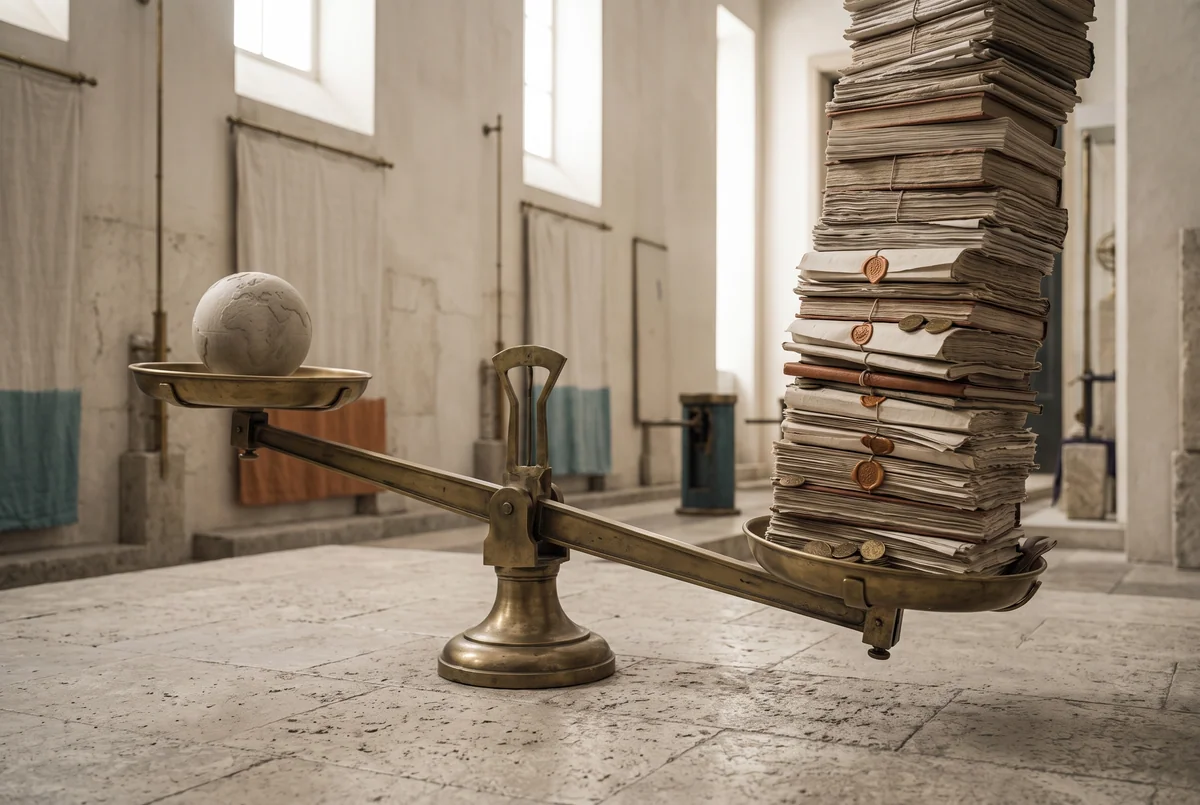
The tower of bets · the abstract financial layer, decoupled from the real world at its feet
World GDP / year~$117 tn
Money supply M2 (liquid)~$96 tn
Global wealth (all assets)~$600 tn
Derivatives (notional value)~$964 tn
The notional value of outstanding derivatives reached around 846 trillion dollars in 2025 (BIS), nearly one quadrillion including exchange-traded contracts. That is roughly eight to nine times real world GDP, and about double the entire wealth of the planet.

IV / VI · Money as Ammunition
War and finance are married. Greenland is the wedding announcement.
The anthropologist David Graeber shows that this is no coincidence: modern money rests on government debt, and states go into debt to wage war. The founding of the central banks was nothing less than the permanent institutionalization of the marriage between warriors and financiers. The Bank of England was created to finance wars; the Federal Reserve made it possible to wage conflicts without an immediate fiscal limit, which prolongs wars, because the pressure to raise taxes disappears.

When one person wants to buy a country
In January 2026, Donald Trump declared the acquisition of Greenland, once called by him “essentially a large real estate deal”, a national priority. He threatened eight European states with tariffs, “due until a deal for the complete purchase of Greenland is reached,” and for a long time refused to rule out military force. The business case? A price tag of around one trillion dollars, with barely any return over two decades.
Greenland is so unsettling because here the stationary bandit briefly turns roving again: open threats, tariffs as economic warfare, land as an object of purchase. The mask slips. Denmark's prime minister drew the only line that counts: security, investment, the economy, all open to negotiation, “but not our sovereignty.” Exactly there, at that boundary, the final chapter begins.

V / VI · The Market Society
How the psyche learns that everything has a price.
The philosopher Michael Sandel describes the quietest conquest of all: over the past decades, market values have crowded non-market norms out of almost every sphere of life. Almost unnoticed, we have drifted from a **market economy into a market *society***: a world in which nearly everything is for sale.

His sharpest example: a day-care centre introduced a fine for picking children up late. And lateness increased. Parents treated the fine as a fee they were willing to pay, instead of understanding punctuality as a duty. The moment a price is attached, a moral obligation tips over into a transaction. Whoever grows up in this world does not learn “some things cannot be bought,” but “everything has a price, I just don't know it yet.”

VI / VI · The Unbuyable
And those whom money cannot reach? You don't buy them. You rename them.
Research on sacred values (Philip Tetlock, Scott Atran) delivers the empirical proof that such people exist. Ask someone to trade a sacred value for money (a “taboo trade-off”) and they respond with outrage, anger, disgust, and become more unyielding in negotiations. The striking finding: an offer of money produces a backfire effect. The person becomes even less willing than if no money were involved at all. To some people, money is not a matter of indifference. It is an insult.
The Dark Answer
So how does the system bring the unbuyable “back under control”? Not with more money. The research shows three routes, and all three are more invisible than any coin:
1 · Reframing · Tetlock
People submit to the taboo trade-off as soon as it is rhetorically reframed as a “routine” or “tragic” trade-off. Vague language of “costs and benefits” masks the betrayal. You don't buy them. You rename the deal until it no longer sounds like betrayal.
2 · Debt Bondage · Graeber
Whoever cannot be won over with money is captured through obligation: student loan, mortgage, rent, insurance. You don't need to buy anyone whose livelihood you have already loaded with debt.
3 · Identity Hijacking · Sandel · Atran
Since sacred values hang on group identity, you redefine the group itself, until the once-sacred value suddenly wears commercial form. The market society, carried out inside the human being.
The most effective control over people whom money cannot reach never runs through money, but through language, debt, and identity. Whoever sees through this is immune.
This is the line running through all six stages: with every stage, the bandit becomes more invisible. Sword, tax, debt, money, market, narrative. Visible violence is expensive and awakens resistance. Invisible violence calls itself normality. Enlightenment means: making the stages visible again.

The Ladder of Control
Six rungs. One movement: from the fist to the thought.
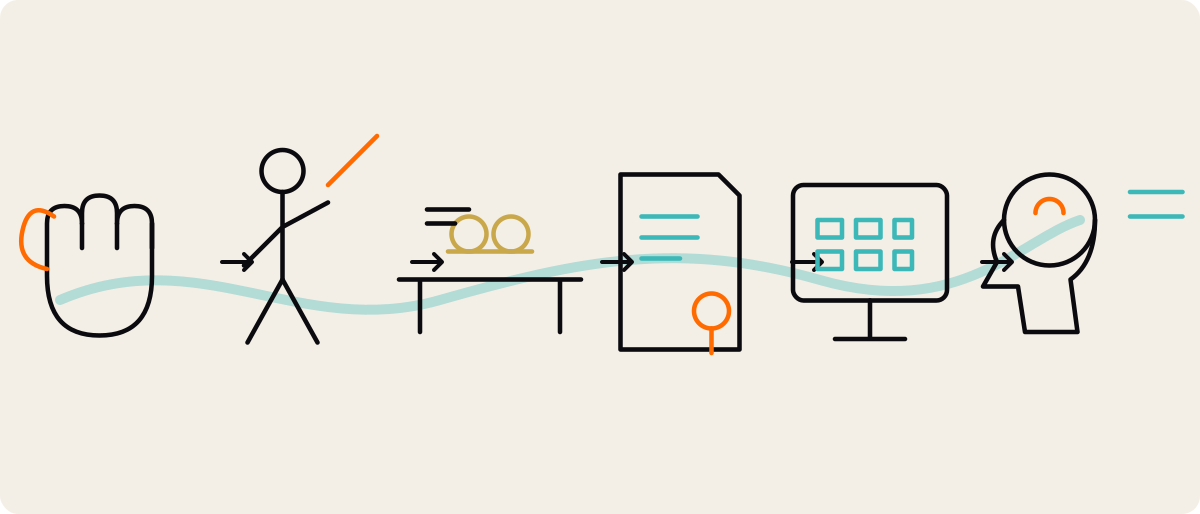
I · The Sword · Visible · raw · expensive
The roving bandit. Pure plunder.
II · The Tax · Half visible · protection for tribute
The stationary bandit. The state as a racket.
III · The Debt · Morally camouflaged · “one pays one's debts”
Obedience without violence. The marriage to war.
IV · The Money · Abstract · self-multiplying
Debt money that must grow. The tower of bets.
V · The Market · Internalized · “everything has a price”
The market society. Control as second nature.
VI · The Narrative · Invisible · in thought itself
Reframing of the unbuyable. The fist has vanished.

Deep Dive · The Deep Layer
What the price does to the soul, and why the number makes us blind.
Dignity or price · the moment a living being wears a price tag, it turns from an end into a means
When life is given a price
Immanuel Kant drew the sharpest line in this whole question: things have a price. They can be exchanged for an equivalent. The human being (and, we may widen it, the living) has dignity. And dignity is “raised above all price” and admits of no equivalent. The moment a living being receives a price tag, it turns from an end in itself into a means. That is not a moral sentiment but a cognitive switch, and it has measurable consequences.
Psychology knows three effects:
- Kennzahl
- 1
- Money priming. The mere thought of money makes people measurably more individualistic, less helpful, more distant (Vohs et al.). Money tunes perception toward exchange instead of relationship.
- Kennzahl
- 2
- Crowding out. The price replaces the inner motive instead of supporting it. Paying for blood donations made donations fall (Titmuss). Money crowds out meaning.
- Kennzahl
- 3
- Numbing. Compassion does not grow with the number of those affected. It fades (Slovic). One face moves us; a million becomes a statistic.
Together they form a tool of cold efficiency: the price turns the living into the comparable, and in the same moment switches off our feeling for it. Thus the unbearable becomes manageable. This is exactly why the axis is needed: a core that by definition carries no price, so that dignity is never dragged into comparability.
The Tyranny of the Number
And with that we come to our great trouble with statistics. Statistics make the world legible. And legibility is the precondition of control. The anthropologist James C. Scott showed: states (and markets) must make populations countable in order to govern them. The census is the tool of the stationary bandit. He must count in order to tax. Statistics are never neutral; from the very beginning they are the lens of power.
Three traps follow from this:
Goodhart's law: as soon as a metric becomes a target, it ceases to be a good measure. Whoever optimizes the number often destroys the very thing it was only a proxy for. The McNamara fallacy: measure what is measurable; ignore the rest; declare the unmeasurable unimportant, and finally nonexistent. The average erases the person: policy made for the mean renders the actual distribution of real individuals invisible.
Statistics can only see what has been made comparable, that is, priceable. A system governed by numbers is blind exactly where dignity lives.
GDP is the object lesson: it measures activity, not well-being. It counts the car crash, the divorce, the oil-spill cleanup as “growth.” It measures, as Robert Kennedy said in 1968, everything except that which makes life worthwhile. The number is the epistemology of the priced world, and its blind spot is no accident, but built in by design.

Seven Perspectives · The Expert Council
One truth, seven lenses. No enemies. Only different horizons.
Each discipline feels out a different part of the same elephant. We lay them side by side, including orthodox economics, which we give its due. Only together does the picture emerge.
Equilibrium
The Economist
SeesPrices coordinate millions of decisions without a central plan; growth has lifted billions out of poverty.
BringsThe discipline of scarcity thinking. And the honest limit of her model.
Complexity
The Complexity Researcher
SeesThe economy as a living, evolving system far from equilibrium: emergence, path dependence, increasing returns.
BringsThe dynamic picture: the future is open, not a point of rest.
Psyche
The Psychologist
SeesMoney changes perception; the price numbs compassion; sacred values fight back.
BringsThe inside view: what economics does to the soul.
Deep Time
The Anthropologist
SeesDebt and countability as age-old tools of power; history knew debt jubilees.
BringsThe reminder: the system is made, and therefore changeable.
Biosphere
The Ecologist
SeesThe economy as a subsystem of the biosphere, subject to entropy; a safe space between a social floor and an ecological ceiling (Doughnut).
BringsThe planet's limits: growth is not boundless.
Dignity
The Philosopher
SeesThe difference between price and dignity; the market society.
BringsThe criterion: what is sacred does not belong on the market.
System
The Systems Thinker
SeesLeverage points; the deepest lever is not the rule but the paradigm from which the system springs.
BringsThe door to change: change the frame of thought, and the system follows.

Way Out · The Alternatives
Many repairs. Each hits one rung. None the whole tower.
Before we propose a path of our own: the honest map of the known remedies, with promise and pitfall. None of them is stupid. Each is incomplete.
Hard Money · Gold · Bitcoin
PromiseMoney that no one can multiply at will. The end of debt inflation.
PitfallDeflationary and rigid: punishes debtors, paralyzes crisis response, rewards early holders. The distribution question stays open.
Full-Reserve Money · Sovereign Money
PromiseTake money creation away from the banks and hand it to a public body: money without debt.
PitfallShifts the power of creation to a central authority. Risky transition, danger of a credit crunch. Who controls the creator?
MMT
PromiseA state in its own currency can never go broke; the limit is inflation, not the deficit.
PitfallPresupposes a political discipline that rarely exists. Does not apply to eurozone countries or the Global South without a reserve currency.
Basic Income
PromiseDecouple survival from the market; dignity independent of wage labour.
PitfallDoes not change who creates money. Funding & inflation unresolved. Can itself become a leash (Ch. VI: debt bondage becomes allocation bondage).
Demurrage Money · Freigeld
PromiseMoney that “rusts”: loses value when hoarded, forces circulation instead of speculation (Gesell, Wörgl 1932).
PitfallCapital flight into other stores of value; hard to enforce; historically only local & brief (Wörgl was banned).
Debt Cancellation · Jubilee
PromisePeriodic forgiveness breaks the exponential debt spiral (Graeber, Hudson).
PitfallA one-off reset, not a structure. Moral hazard. Massive resistance from creditors.
Central Planned Economy
PromiseSocialize capital; orient production toward need instead of profit.
PitfallThe calculation problem (Mises/Hayek): without price signals, no efficient allocation. Concentration of power, historically authoritarian.
Pure Market
PromiseDecentralized price signals allocate better than any planner. Freedom & innovation.
PitfallExactly the pathology of this essay: financialization, commodification of everything, inequality, boom and bust.
Cooperative · Commons
PromiseOwnership & decision-making with those involved; the market in service of the common good (Shalem model).
PitfallScaling: often remains a niche. Cannot replace the national monetary order, only complement it.
The pattern is clear: almost every design treats capitalism and communism as an either-or, two towers to choose between. That is precisely the thinking error of two hundred years. Both carry a truth. Both carry a shadow. What if one did not choose them, but interlocked them?

The Horizon · From Resting Point to Flow
We calculate with the physics of 1870. But the world is a living system.
From clockwork to swarm · the rigid equilibrium dissolves into a living, never-resting order
Classical economics borrowed its worldview from nineteenth-century mechanics: a system striving toward a stable equilibrium, populated by rational optimizers. That was a great achievement, for an industrial world. But it is a still photograph of a flowing river.
Dignity matters here, not blame. The “economic sages” and their colleagues worldwide are neither sorcerers nor adversaries. They are cartographers. And their map was astonishingly accurate for its terrain. But the terrain has changed: digital, financialized, at the ecological limits, complex and interconnected. A map of the calm river helps little once the river bursts its banks. The problem is the paradigm, not the person.
◷
The old picture: equilibrium
AssumptionsMechanical, one point of rest, the rational actor, growth without limit. The average rules.
Blind spotNovelty, change, the unmeasurable, the living individual.
❋
The living picture: flow
AssumptionsComplex-adaptive, far from equilibrium, learning actors, limits and renewal. The individual counts.
DemandsThe courage to stay open: no closing formula, but living governance.
Donella Meadows, pioneer of systems thinking, showed: the most powerful leverage point of a system is not a rule or an interest rate. It is the paradigm from which the system springs. If you truly want to change the system, you change the frame of thought. A dynamic future begins not with a new regulation, but with a new image.
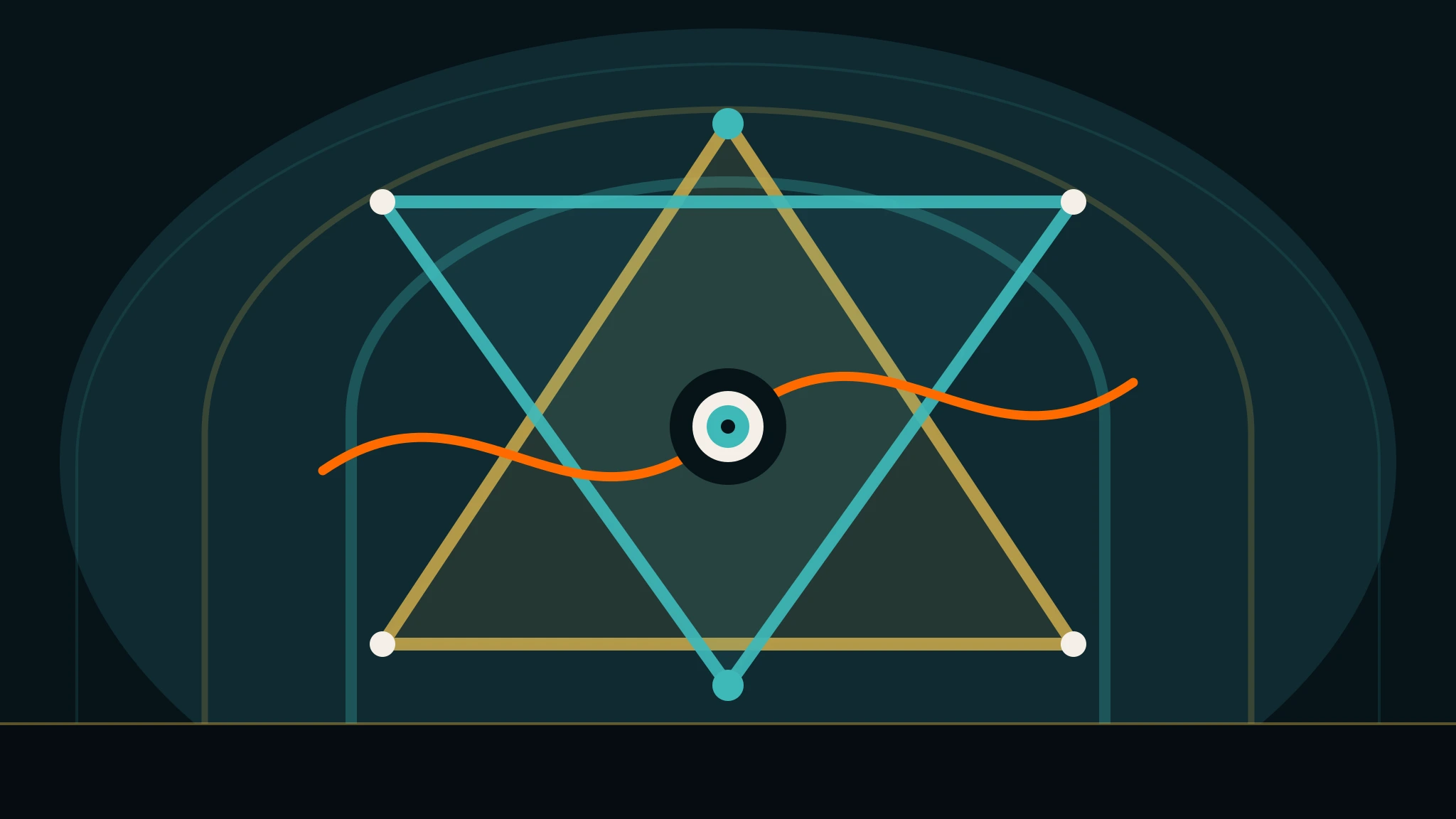
And this is exactly where the Merkaba is no accidental symbol. The equilibrium of the old economics is a standstill: two forces neutralizing each other. The Merkaba is the opposite: two tetrahedra that rotate against each other and never come to rest. Living equilibrium is movement, not standstill. A dynamic future needs a dynamic image. And that is precisely what the third pillar delivers.

The Solution · The Third Pillar
Chazon: two systems, counter-rotating, held by an unbuyable axis.
The Merkaba · market tetrahedron (gold, upward) and commons tetrahedron (violet, downward) in equilibrium around the resting core
The Merkaba (the star tetrahedron, two pyramids interlocked within each other) is no symbol of compromise. A lukewarm “third way,” a mixed economy, would be only half an engine on half a floor. The Merkaba is a counter-rotating equilibrium: both principles fully present, rotating against each other, each limiting the other's shadow.
△
The Engine: Market & Capital
TruthDecentralized initiative and price signals allocate better than any planner. Freedom, competition, inventiveness.
ShadowExtraction, financialization, the commodification of everything.
▽
The Floor: Commons & Solidarity
TruthSome things must not depend on the market: care, basic security, what we hold in common.
ShadowCoercion, the calculation problem, concentration of power.
The Axis: Chazon, the Resting Core
At the centre of the Merkaba stands not a system, but a measure. The axis (Chazon, “vision”) is the unbuyable core that neither market nor state may price or own: human dignity, life, the commons of nature, care, meaning. Exactly what Chapter VI defends. With this, the axis answers the question Sandel left open. He never named the criterion for what may become market and what may not. The criterion is sacredness: whatever belongs to human dignity is constitutionally removed from both tetrahedra.
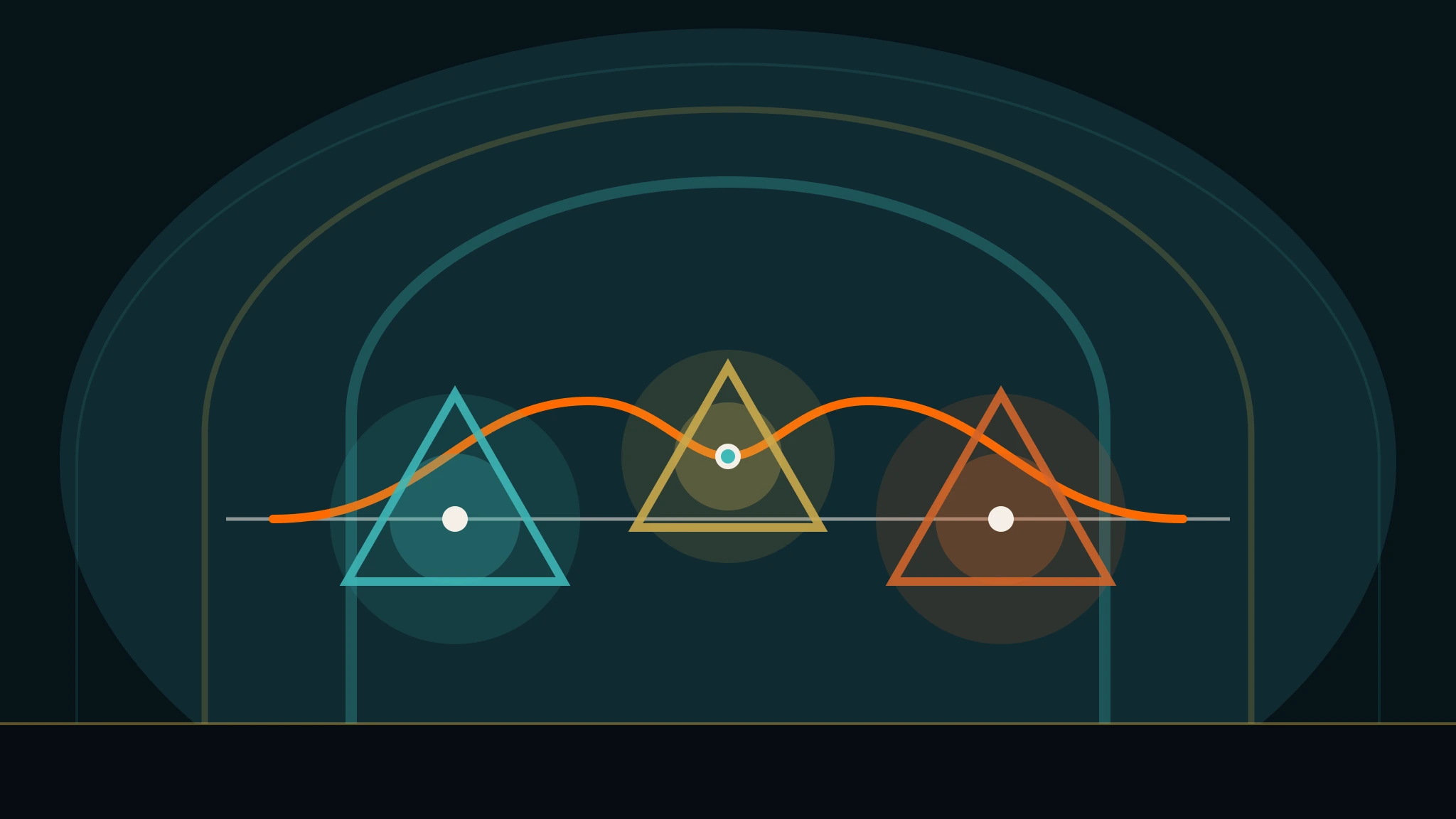
Layer 1 · Pillar Shalem · The Floor: debt-free money for the non-negotiable
Publicly created, debt-free money carries care, dignity, and the ecological commons. The communist truth, without the coercion.
Layer 2 · Pillar Merkaba · The Engine: a free market on the floor, not in its place
Competition and price signals for everything that genuinely benefits from them, carried by the floor, never replacing it. The capitalist truth, without the raids.
Layer 3 · Pillar Chazon · The Axis: the core that prices nothing
It prices nothing. It draws the line: what may become market, and what never? The axis holds engine and floor in equilibrium.
Capitalism asks: “What is it worth?” Communism asks: “Who owns it?” Chazon asks first: “What is sacred, and therefore must never come onto the market in the first place?”
Only this third question holds the other two in balance. That is the third pillar, not between the systems, but above them.

Sources & Evidence
All verifiable. Nothing invented.
- 1 · Mancur Olson, “Dictatorship, Democracy, and Development” (1993) & “Power and Prosperity” (2000). Theory of the stationary bandit.
- 2 · Charles Tilly, “War Making and State Making as Organized Crime” (1985). The state as a protection racket.
- 3 · Bank of England, “Money Creation in the Modern Economy,” Quarterly Bulletin 2014 Q1. 97% of money created through credit.
- 4 · BIS, OTC derivatives statistics, as of June 2025: $846 tn notional value; ~$964 tn incl. exchange-traded.
- 5 · McKinsey Global Institute, “Out of Balance” (2025): global wealth ~$600 tn, driven by debt.
- 6 · UBS / IMF, Global Wealth Report 2025 ($471 tn personal wealth); world GDP 2025 ~$117 tn.
- 7 · David Graeber, “Debt: The First 5000 Years” (2011). Debt as power; the marriage of war and finance.
- 8 · Michael Sandel, “What Money Can't Buy” (2012). Market society & crowding out.
- 9 · Tetlock et al., “The Psychology of the Unthinkable” (2000) & “Sacred Values and Taboo Cognitions” (2003). The backfire effect.
- 10 · Congress.gov / Al Jazeera / House of Commons Library, Greenland crisis, January–June 2026.
- 11 · Mises / Hayek, the socialist calculation debate: without price signals, no efficient allocation.
- 12 · Silvio Gesell, “The Natural Economic Order” (Freigeld); the Wörgl experiment 1932/33.
- 13 · Positive Money, full-reserve / sovereign money reform; the Chicago Plan.
- 14 · Michael Hudson, “…and forgive them their debts” (2018). Debt forgiveness as historical practice.
- 15 · Immanuel Kant, “Groundwork of the Metaphysics of Morals” (1785). Dignity vs. price.
- 16 · Vohs, Mead & Goode, “The Psychological Consequences of Money” (Science, 2006). Money priming.
- 17 · Paul Slovic, “Psychic Numbing & Genocide” (2007). Compassion fades as the number grows.
- 18 · Richard Titmuss / Deci & Ryan, crowding out of intrinsic motivation (blood donation; self-determination theory).
- 19 · James C. Scott, “Seeing Like a State” (1998). Legibility as the precondition of control.
- 20 · Goodhart / Yankelovich, Goodhart's law; the McNamara fallacy.
- 21 · Donella Meadows, “Thinking in Systems” & “Leverage Points” (1999). The paradigm as the deepest lever.
- 22 · W. B. Arthur / E. Beinhocker, complexity economics; “The Origin of Wealth.” The economy as a living system.
- 23 · Daly · Georgescu-Roegen · Raworth, ecological economics & “Doughnut Economics.” Floor and ceiling.